
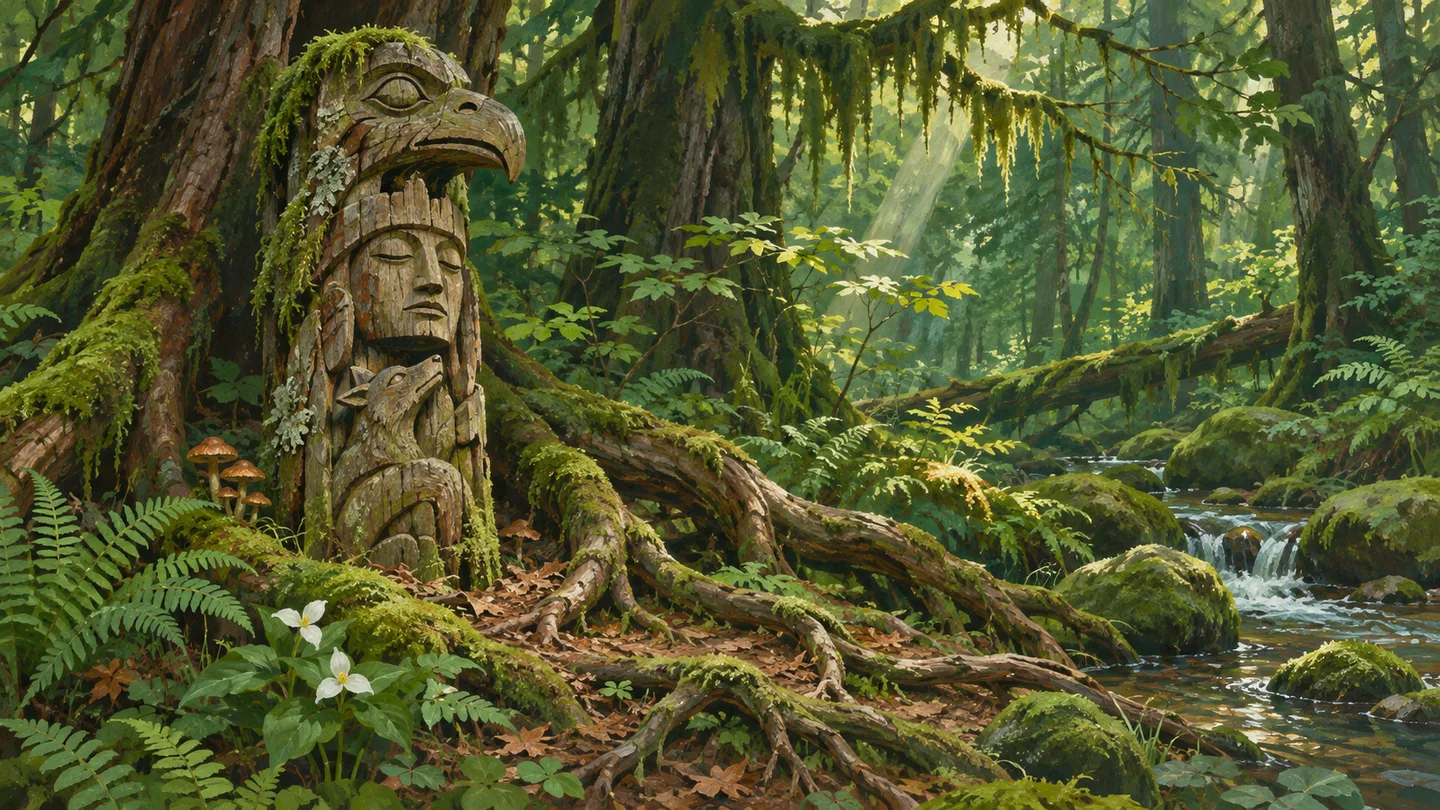
How we read a forest
Mofern Studios designs quiet investigations set in old-growth woods. Our ranger carries a journal, and the forest supplies evidence through sound, movement and terrain.
- Listen
- Record what disappears from an otherwise familiar soundscape.
- Observe
- Pair every key audio cue with something visible on the ground.
- Restore
- Return after an intervention and look for a change you can recognise.
Revisiting the same place
We design an investigation as two visits to a place the player can recognise. On the first visit, the ranger records an absence at the canopy and a visible clue near the ground. The route back starts with those observations. If the river has risen or the light has changed, the journal still needs to tell the ranger where to look.
How we test the clues
We run the same survey with sound on and off. A player using audio can hear where the canopy drops away. Someone reading the landscape can follow a change in leaf litter or the shape of exposed roots. During the return survey, we check whether the player can point to what recovered and what still needs attention.
How the design comes together
We work from observations before assigning meaning. Narrative design writes the question a ranger takes into a clearing. Sound design gives the player something they can compare on a return visit. Environment art determines how a sign can be recognised under different light, and systems design decides which changes can plausibly follow an intervention. Each role can challenge a clue. A strong note names the evidence the player had, why it pointed toward a hypothesis, and what later evidence changed the interpretation. The Grove Index organises these questions around places where multiple clues meet, so a single sound or colour never has to explain the entire forest.
One review compares the same clue at two times of day. It can reveal that a colour change is doing all the work, or that the text description leaves out an important direction. Those are separate problems that the art and interface can solve together.
See Rootbound Crossing for an example.